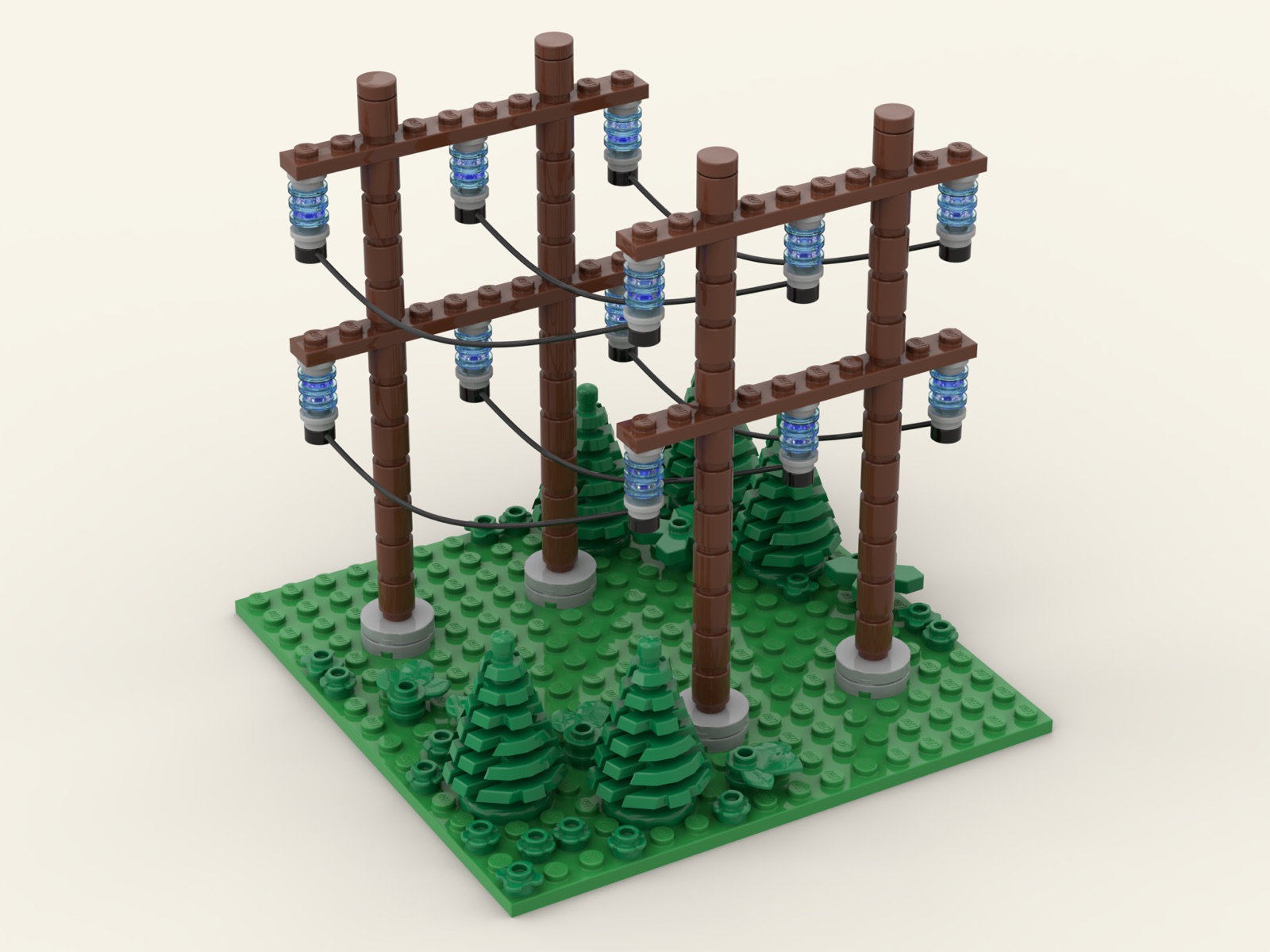
Wooden H-Frame
Twin timber poles and a crossarm, the heavy structure of the early grid. Built for the Grid of the Future collection as its look backward: a reminder that much of the old grid is still standing and still in service.
A corridor, not a tower
A single H-frame is just one structure. For this one I wanted a corridor instead, so I lined up several small frames, ran the conductor between them, and added some underbrush along the base. Once it was a row rather than a single tower, it started to look like an actual stretch of line going somewhere. The insulators still do a lot of the work even at this size, and honestly a lot of that is the translucent blue bricks standing in for the glass.
This is part of the Grid of the Future collection, designed in the same sprint and under the same cost pressure as the others. It is the only one of the four I didn't have to scale down from something bigger; at this size I could build it cheaply enough from the start. It is also where an idea I keep returning to finally pays off, one that runs back through the distribution pole and the larger wooden H-frame this grows out of: I am less interested in the single structure than in what happens when you repeat it.
The future arrives slowly
Every exhibit about the future needs one honest reminder of how slowly it actually arrives, and in this collection that job falls to the wooden H-frame. BEPCO put it in not as history but as fact: structures like this one, raised in the founding era, are still carrying line today, long past the service life anyone drew up for them. The Company's records track a few of the originals with something close to affection, the way you might a machine that has outlasted every engineer who condemned it. Its Instruction Booklet is the oldest design in the collection, and the one most likely to outlast it.