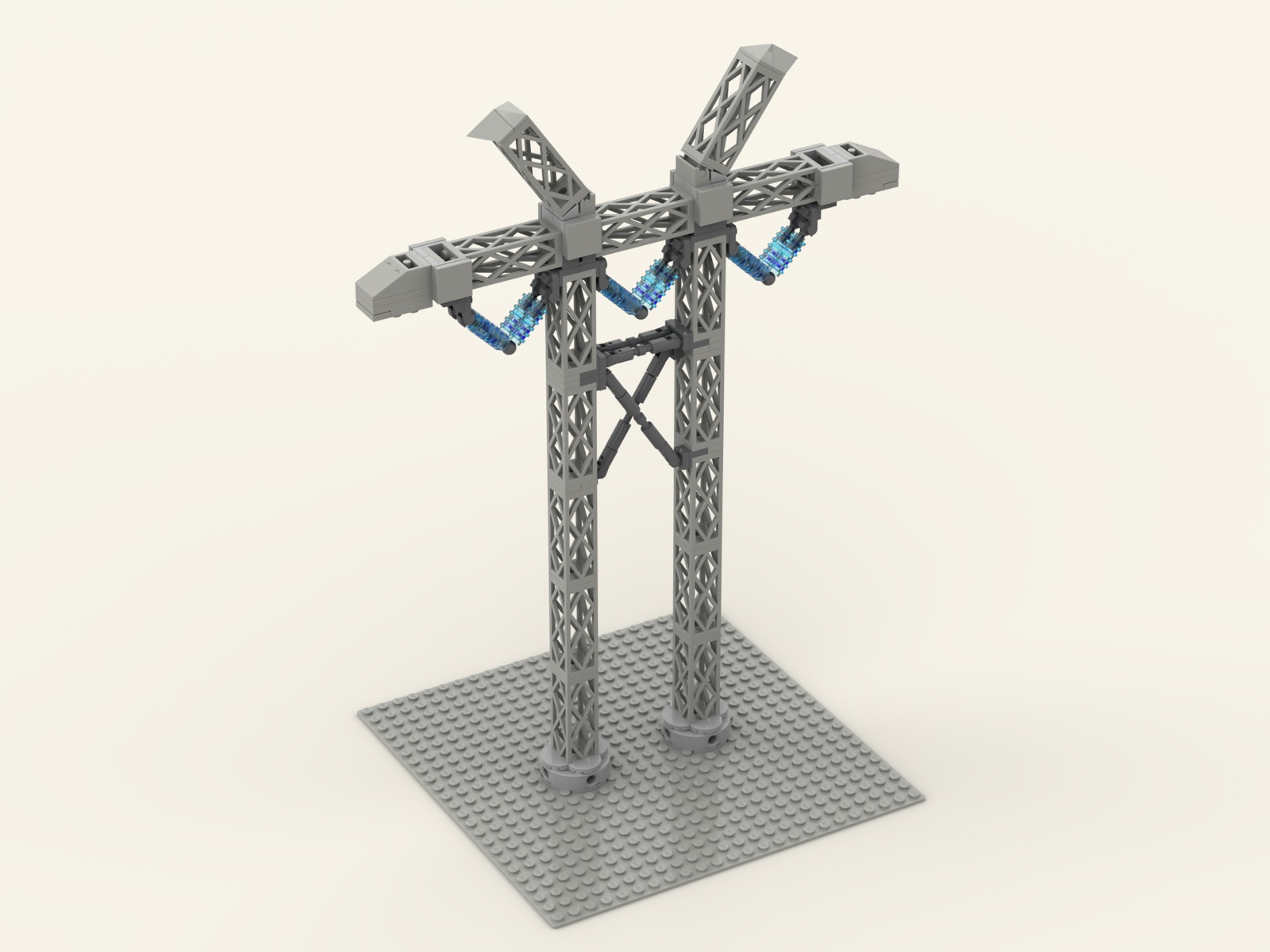
Large Lattice H-Frame
A bolted-angle tower of steel lattice that carried postwar transmission at voltages and spans timber could never reach. The workhorse of the buildout years: rustable, repairable, and strung by the mile across open country.
All on one brick
This is the steel version of the H-frame: the same two legs and a crossarm as the wooden one, but built from a lattice element so it reads as angle iron rather than timber. The shape is deliberately plain and, like the wooden frame, meant to repeat into a line. What character it has comes from the lattice standing in for bolted steel, which is the look I was after.
This was another step toward the classic lattice tower I keep circling, reached the way I reached the last rung: by moving up from the wooden H-frame to its steel cousin. What I did not expect was to fall for a single brick. There is a rare LEGO lattice element I became enamored with here, expensive and hard to find, but it works so well that I am already planning full substation structures around it. The hardest parts of the build were the connections that carry the neutral and the spots where the structure changes, which I wanted to cover without adding anything the form did not need. These stay simple to look at but end up costly to own, because the per-unit price of those lattice bricks is high. One irony I have made peace with: this exact brick would not carry over to a large classic lattice tower, so the technique is a dead end for the goal I am chasing. Unfortunate as a design challenge, fortunate for anyone's parts bill. It moved me closer anyway, and taught me what I will and will not get to reuse when the big tower arrives.
Bolted to last
When timber ran out of reach, BEPCO turned to steel. The lattice H-frame traded tall trees for angle iron and an almost unreasonable number of bolts, carrying the postwar buildout across country the founding grid had never reached. It was never called handsome, and never pretended otherwise, but it galvanized well, rusted slowly, and could be climbed and repaired by anyone with a wrench and a head for heights. The Company keeps it in the records as the mid-century workhorse it was, and its Instruction Booklet accounts for every last bolt.