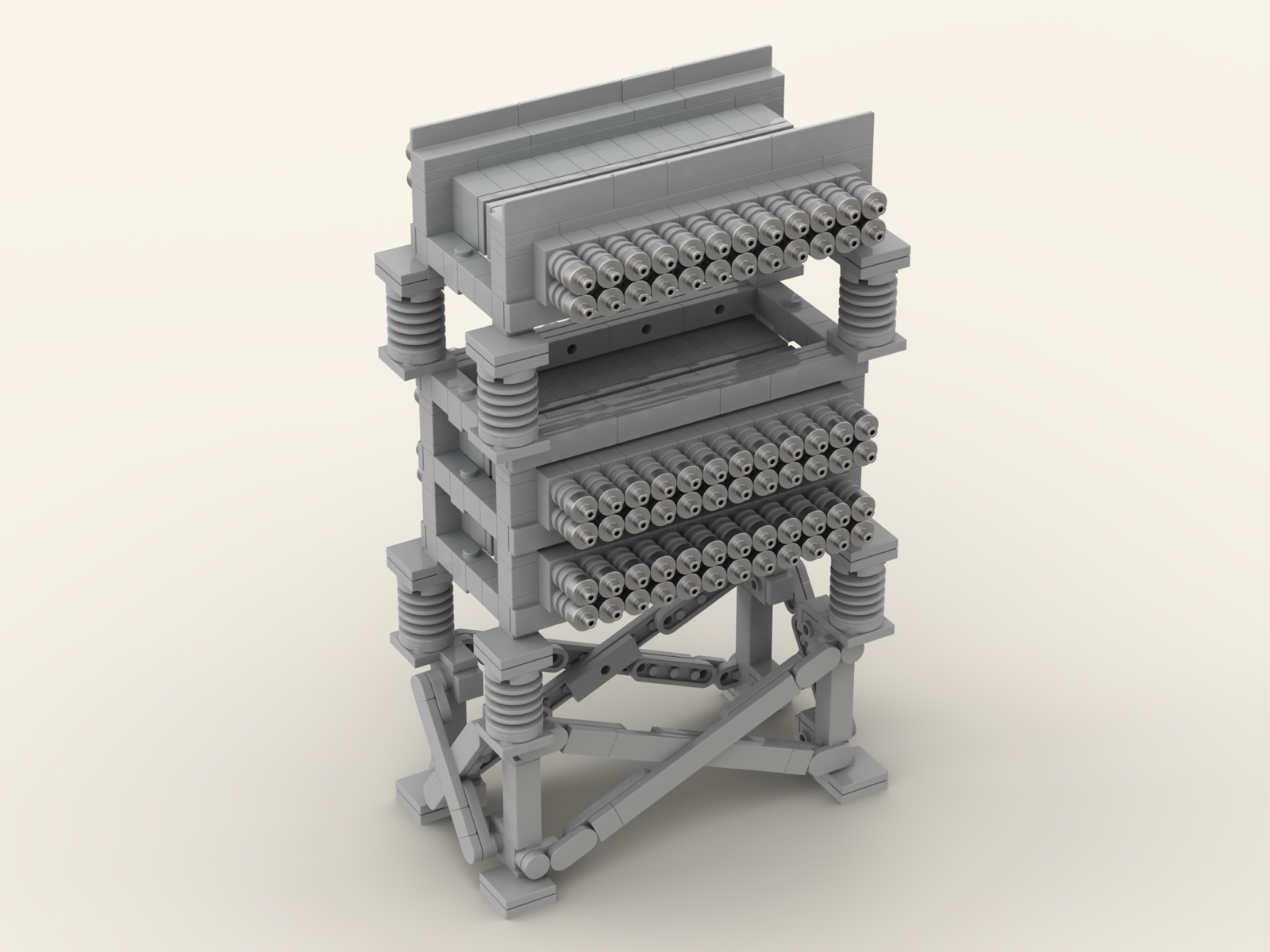
Capacitor Bank
A steel-framed array of capacitor cans from the transmission switchyard, supplying the reactive power the grid constantly draws to correct power factor and hold voltage steady across long distances. As load rises and voltage begins to sag, the bank switches in to compensate the drop.
The sum of small parts
A capacitor bank is a study in repetition: rows of matching cans racked on a steel frame and wired together into a single unit. Its role is a substantial one. It supplies reactive power to regulate voltage, manage power factor, and keep the system stable across long transmission distances, stepping in as load climbs and voltage starts to sag. The form is what drew me to it: there is something satisfying about a structure built from many small, identical parts, the way they add up to real presence without any one of them drawing the eye, and I wanted the model to carry that same ordered bulk.
I built this one straight off reference photos, which gave me enough confidence that I could get a convincing set out of it. Honestly, it has the least color variation of anything I have designed so far, and that still bugs me. I also did not break the build into submodels as cleanly as I should have, so the instructions ran longer than they needed to; a mix of impatience and wanting to get it published carried me past the point where I would have gone back to tidy them. What redeemed the build was the excuse to work out a new technique for the lattice steelwork that sits under most substation equipment, noticeably different from the lattice beneath the SF₆ breaker I released earlier. I also tried a few sizes for the individual capacitors, and I suspect there is a larger version of this bank in my future.
The power that does no work
Of everything in the switchyard, the capacitor bank is the hardest to explain to a visitor. It supplies reactive power: the kind that does no useful work, yet the system can't support its voltage without it. BEPCO added banks like this through the mid-century as its growing towns needed compensation, switching in as load rose and out as it fell, correcting a problem most of the townsfolk downstream never knew they had. The Company's archive record files it under indispensable, if unglamorous, and its Instruction Booklet explains the reactive part better than most engineers can.