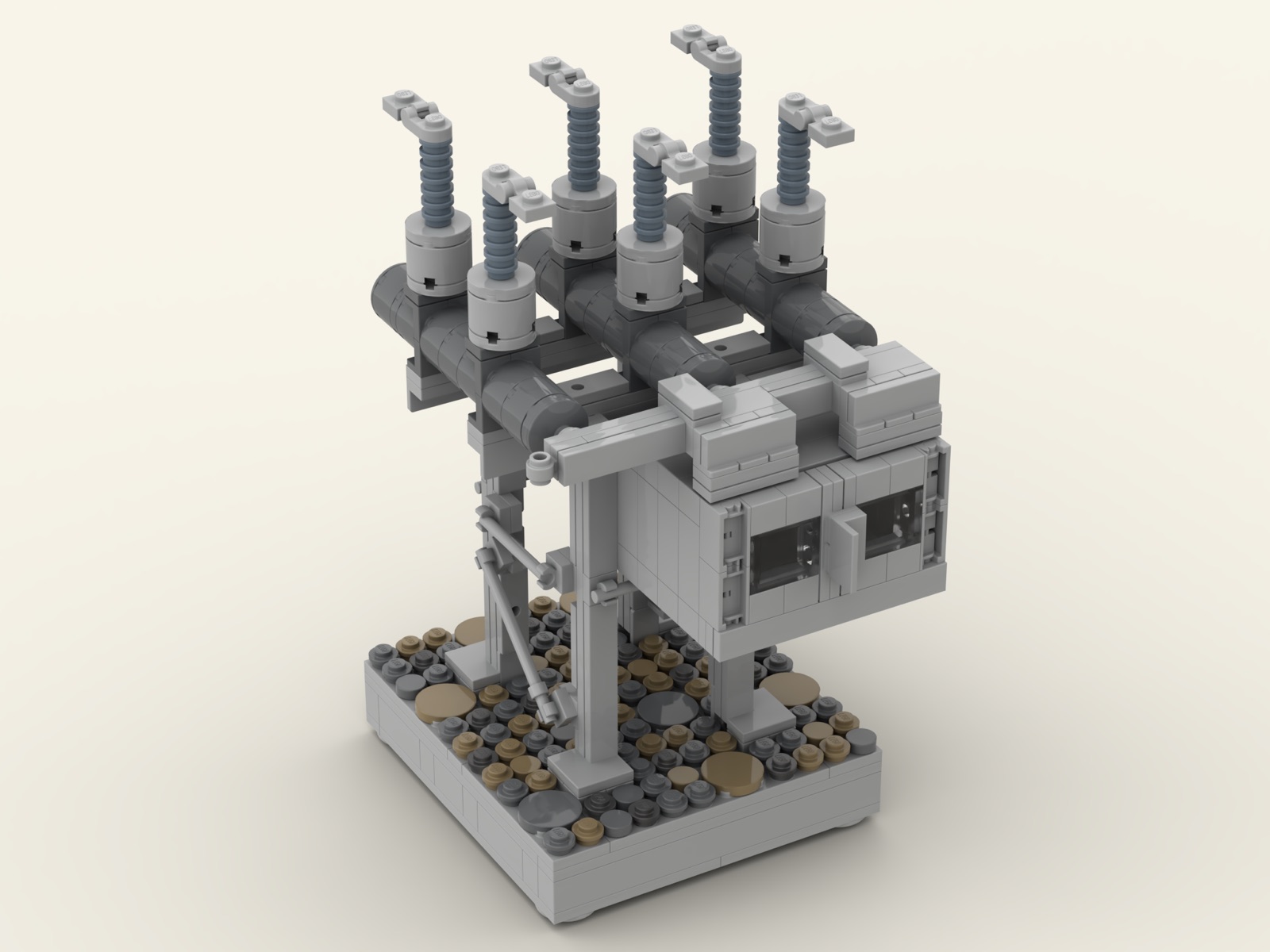
SF6 Circuit Breaker
Acting as the grid's protective reflex, it interrupts faults in milliseconds, quenching the arc inside a sealed chamber of SF₆ gas to prevent damage and maintain system stability.
Right angles at rest
Most of what keeps the grid safe never moves. The circuit breaker sits in the switchyard looking completely inert, and that stillness is the point: it is built to wait, and to be right the one time it finally acts. I wanted to model a piece of that hidden safety layer, the equipment we get to ignore precisely because it is doing its job, and to make the intention engineered into it a little more visible.
I picked this breaker to capture the purposeful symmetry of high-voltage design, and for a practical reason too: it is built almost entirely from straight lines and right angles. A lot of real SF₆ breakers angle their insulators out in different directions, which is a big part of their signature look, but at this scale the insulators are tiny and that geometry got very hard to pull off, so I saved it for a future, larger SF₆ build. Detail-wise this one sits at the small end of the range; the 2×2 round bricks I used for the SF₆ vessels are about as compact as I could go while still keeping detail on the insulators. Color was the other compromise: the stainless-steel current transformers really want a metallic silver that does not exist in these brick shapes, so once I settled on grey-blue insulators and dark-grey vessels, the CTs landed on a light grey that unfortunately matches the structure. Even with those tradeoffs it was a genuinely fun build, and it left me eager to take on something bigger and more detailed.
Muscle memory
Every substation keeps one type of equipment whose whole career may come down to a single instant, and this is it. Sealed in SF₆ and idle for potentially years at a time, the breaker interrupts a fault the moment it appears, doing without spectacle what BEPCO's older oil-filled units had done since the mid-century. It is rarely thanked for the work: the town sees the blink when the line recloses, sees rather more when it locks out and the lights stay down, but never sees the wrecked transformer or the burned span because it was spared. The Company's archive record judges the machine, fairly, on those few operations, and its Instruction Booklet is the closest thing to thanks it will ever get.