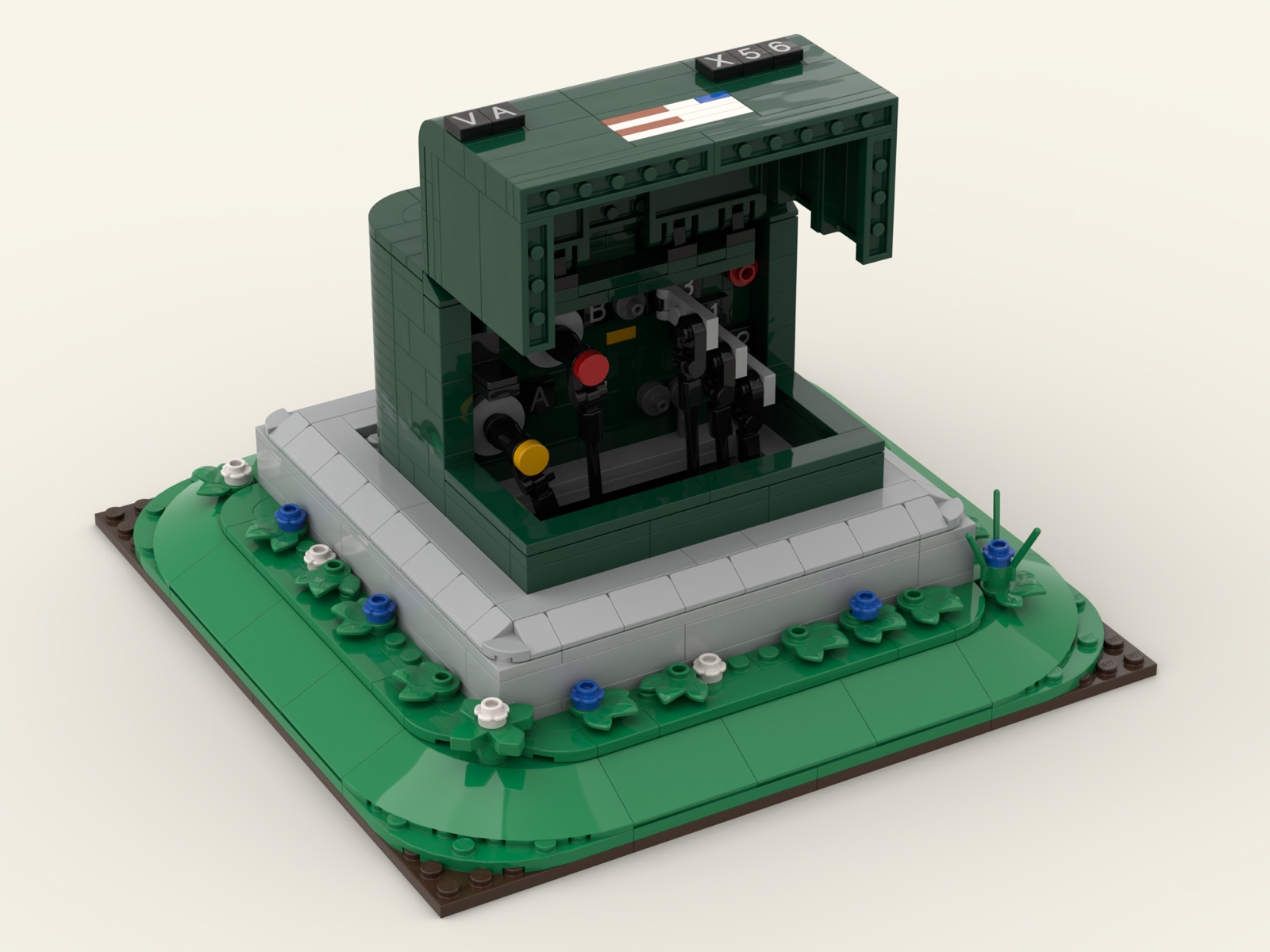
Padmount Transformer
The locked green cabinet on a concrete pad that steps distribution voltage down to usable service, feeding the buildings around it through underground lines. Found in neighborhoods and industrial spaces alike, it is the last transformation before the meter.
Inside the ordinary
The padmount transformer is easy to walk past, which is exactly why I wanted to build one. It's a familiar shape, the low green cabinet on its pad, but almost no one has seen what's inside, so the model opens up: a removable panel and an articulating hood reveal the connections and the cables running down into the ground toward the rest of the grid. A little greenery around the base keeps it honest, since these are always half-tucked into a hedge or a corner lot anyway. I wasn't trying to make it grand, just to make the everyday version of it worth actually looking at.
This wasn't the first infrastructure model I'd pictured, but it was the first I could actually see how to build. Up to that point I'd designed exactly one MOC, a Super Mario build, and spent a while assembling other people's sets from digital instructions in Bricklink Studio, so the padmount was really me testing a theory: could I build something from my own field, in bricks? Its simple shape and unmistakable green made it a safe first attempt, and by the time I reached the interior I'd talked myself into overachiever mode. The parts that fought back were the ones I ended up caring about the most: getting the conductor bars angled right and the hood to actually articulate in the design tool.
Closer than you think
For most people the padmount is the nearest they will ever stand to the electrical grid, and they manage it without noticing: leaning a bicycle against it, letting the dog investigate, mistaking its low hum for the weather. The Company thinks rather more highly of the thing. It is the last transformer between the distribution line and the lamp in the window, kept to a filed specification so that the green box on one corner is, reassuringly, much like the green box on the next. Its booklet reproduces that specification in full, required reading for absolutely no one, and yet here it is.